Best Copper Pipe Benders for DIY Plumbing UK – 15mm & 22mm Picks
Bending copper pipe by hand without the right tool leaves you with creased, weakened pipe that either splits or restricts water flow. A decent pipe bender costs £20–£80 and transforms a frustrating job into something you can actually do yourself. Whether you're routing heating pipes through a loft or rerouting bathroom supply lines, the right tool makes all the difference.
Spring Benders: Dead Simple, Most Versatile
Spring benders slide over the pipe and let you bend gently by hand. They work by supporting the pipe from the inside, preventing collapse. For 15mm copper, they're reliable for gentle bends in heating and water supply work.
The main advantage is simplicity. No moving parts, no setup time, and they're the cheapest option. You can make a 90-degree bend in heating pipe without the tool jumping or slipping. For bathroom projects where you need to thread supply under floorboards or around joists, they're often the first choice because they're forgiving on smaller radii.
The limitation is control. With spring benders, you're relying on feel, and if you rush or use too much force, you can still crease the pipe. They're also awkward if you're working in a tight space—there's no leverage, so bending 22mm copper by hand takes real effort. Many people find that bending 22mm this way either takes several goes or damages the pipe.
Lever Benders: The Practical Middle Ground
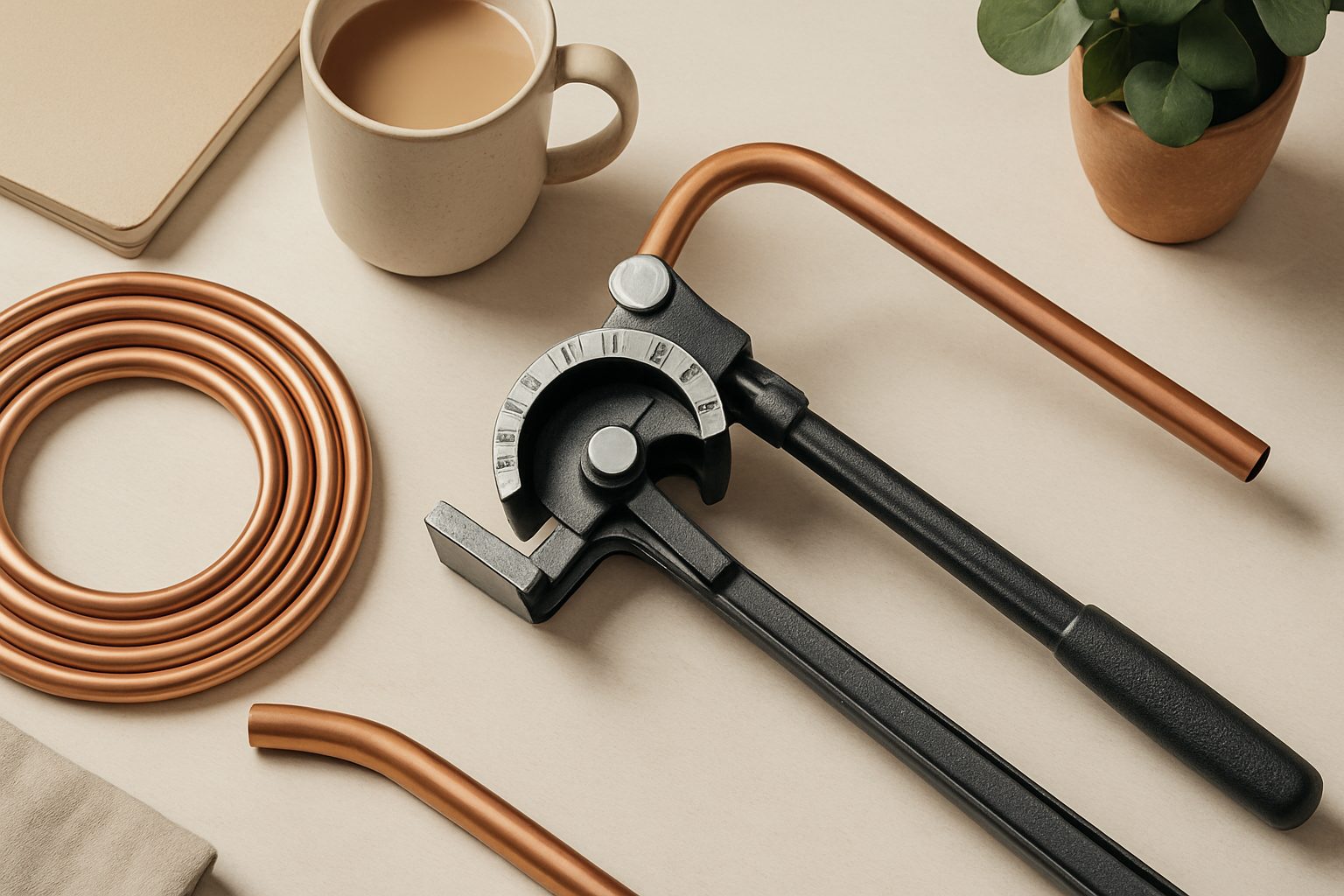
Lever benders have a fixed former (the bend guide) and a long handle that you squeeze or pull to bend the pipe. For 15mm copper they're quick, and for 22mm they give you mechanical advantage so you don't exhaust yourself.
What makes them useful is consistency. You position the pipe at the angle you want, and the lever mechanism ensures a uniform bend. There's less guesswork than with a spring bender, and they handle both 15mm and 22mm without complaint. If you're installing a heating manifold with multiple bends, a lever bender cuts the time and frustration significantly.
The trade-off is that they're bulkier and take up more space. In a confined loft or under a sink, maneuvering a lever bender can be tricky. You also need a bit of space to pull or squeeze the handle. Some models are adjustable for different pipe sizes, which is convenient if you're doing a mixed job, but cheaper fixed-size models are tighter and sometimes harder to load.
Ratchet Benders: Maximum Control for Tight Spaces
Ratchet benders use a wheel that you turn, gradually curving the pipe instead of forcing one bend at once. They give you fine control and work brilliantly in confined areas because you can hold them steady with one hand and ratchet with the other.
For bathroom plumbing especially, where you might need several 90-degree bends and the pipes are already hemmed in by walls and joists, ratchet benders shine. You can walk the bend gradually, which also reduces the risk of creasing. Both 15mm and 22mm copper bend smoothly, though 22mm requires more turns and a bit more patience.
The downside is time. A full 90-degree bend might take 20–30 turns of the ratchet, whereas a lever bender does it in one or two pulls. If you're bending dozens of pipes, the repetition adds up. They're also pricier than spring or basic lever models.
What to Actually Look For
Size mismatch is the main reason people buy the wrong bender. Check what size pipe your job needs (15mm is standard for heating and most water supply; 22mm for larger distribution branches). A bender that's loose on the pipe won't work; one that's too tight won't load.
Check the radius. Most domestic copper bends work fine with a 90–100mm radius, but some jobs need tighter bends. Ratchet benders often do these better than lever models.
Material matters. Steel-faced formers and hardened steel handles last longer than aluminium, especially if you're bending repeatedly or working with aggressive angles.
One-size-vs-dual-size models. A bender that handles both 15mm and 22mm costs more but saves buying two tools if your project mixes sizes.
Spring vs Lever vs Ratchet: The Short Version
Use a spring bender for gentle, occasional bends in heating pipe where you've got space and time. They're cheap and fuss-free.
Choose a lever bender if you're doing a straightforward job with several bends—bathroom supply reroute, heating loop installation—and you want speed and consistency without fiddling.
Pick a ratchet bender if you're working in tight spaces, need to avoid creasing, or want fine control. The slower pace is worth it if the alternative is damaging pipe and starting over.
The Real Cost of Getting It Wrong
Bending copper badly—creasing, flattening, kinking—restricts flow. Kinked heating pipes slow water circulation and can cause microbubbles. Supply pipes that are flattened or split need replacing, which means draining sections, unsoldering, and starting again. A £30–£50 pipe bender pays for itself if it saves even one repair.
Start with the tool type that matches your workspace and the number of bends you're making. For most DIY plumbing jobs in the UK, a decent lever bender in the right size handles the work with minimal fuss.
More options
- Clarke Pipe Benders (Clarke PB16F & Clarke Strongarm range) (Amazon UK)
- Silverline Pipe Benders & Spring Bender Sets (Amazon UK)
- Monument Pipe Bender & Lever Bender Range (Amazon UK)
- Hydraulic Pipe Bender Kits (12T / 16T multi-former sets) (Amazon UK)
- Rothenberger Rocbend & Copper Pipe Bender Sets (Amazon UK)