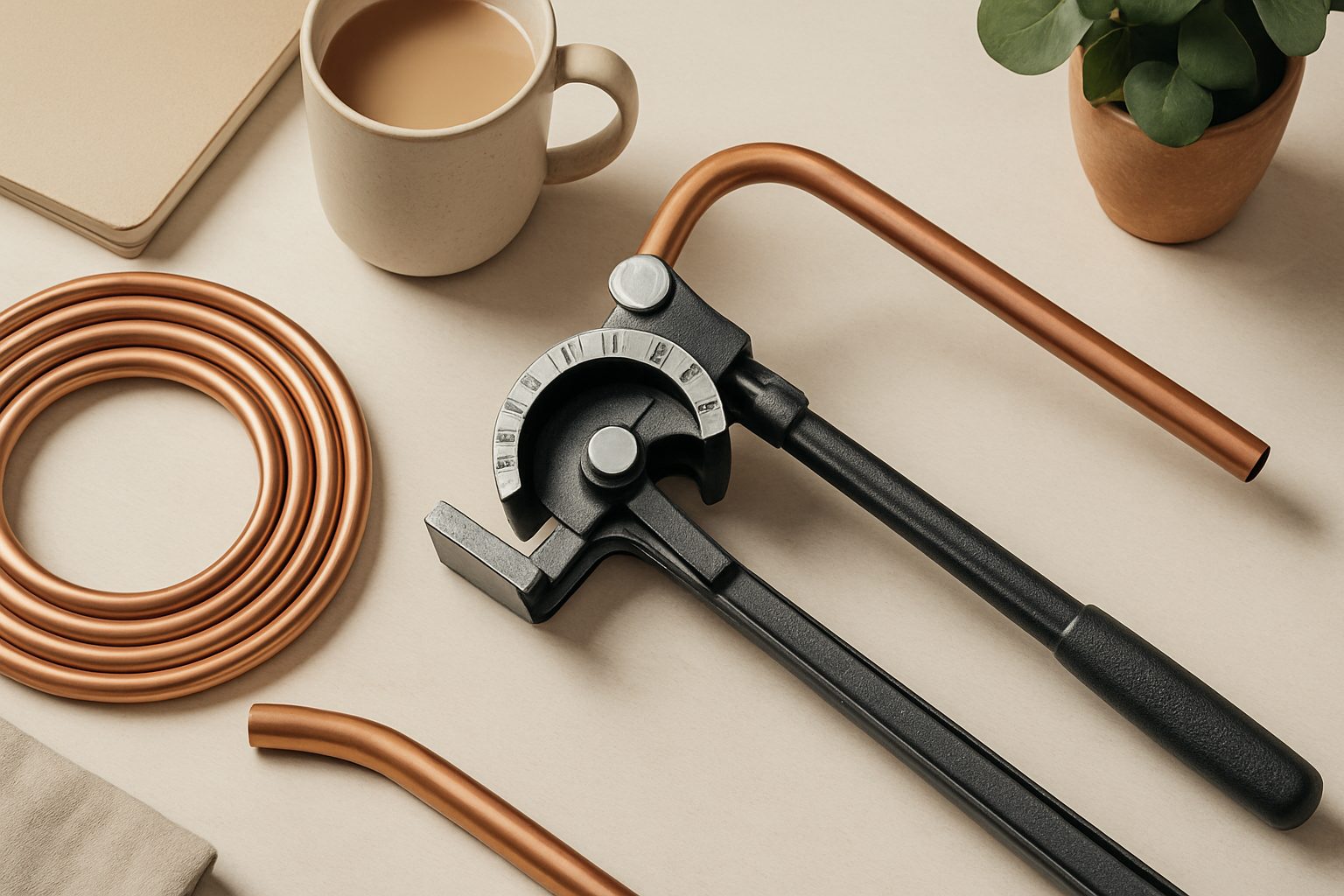
Best Heavy-Duty Pipe Benders for Home Workshops UK
If you're fabricating steel tube in a home workshop, a proper pipe bender transforms frustrating guesswork into repeatable, accurate work. Heavy-duty models handle the steel tubing that hand tools simply can't manage—anywhere from 8mm to 22mm outer diameter—without the crushing cost of industrial equipment.
The challenge is finding one that balances genuine capacity with space constraints and budget. We've looked at what actually works for hobbyist fabricators doing serious work, not light DIY projects.
Why Dedicated Pipe Benders Matter
Attempting to bend steel tube with pipe bending springs or hand tools damages the tube, creases bends, and often leaves work unusable. Dedicated benders support the tube properly on both sides of the bend, maintain consistent radius, and apply force evenly. For anything thicker than thin-wall mild steel, you're fighting a losing battle without one.
The jump from budget hand models (typically rated to 10mm) to genuine heavy-duty equipment is significant, but that's where the capability lies. If you're working regularly with 12mm or larger tube, a heavier machine stops being a luxury.
Manual Hydraulic Models: The Sweet Spot
Clarke Strongarm and similar manual hydraulic benders are genuinely the workhorse choice for home workshops. These are bench-mounted machines with a hydraulic pump you operate by hand. They typically handle tube up to 16–22mm OD depending on the specific model, which covers the vast majority of practical fabrication work.
What makes them appealing:
- Reliable force delivery: The hydraulic system applies steady, controlled pressure. No guessing whether you've bent far enough, no sudden slips.
- Consistent results: Same radius, same angle, every time. Once you dial in the bend, you can repeat it.
- No electricity needed: Useful if your workshop power is limited or unreliable.
- Durable: These machines are relatively simple—fewer components mean fewer things to break.
The trade-off is physical effort. Hydraulic hand pumps require proper technique and reasonable fitness; some users find repeated pumping tedious for large batches. They're also slower than powered alternatives.
Pricing for reputable manual hydraulic models sits between £400–£800, depending on capacity and build quality.
SIP and Benchtop Hydraulic Options
SIP (Sump, Industri & Produkter) manufactures benchtop hydraulic benders that are electrically powered, which removes the manual pumping. These machines typically run on 240V and can handle tube up to 22mm OD. The pump operates automatically, so you position the tube, operate a lever or valve, and the machine applies the bend.
Advantages over manual hydraulic:
- Less physical effort: Especially valuable if you're bending many tubes or working with stiffer material.
- Faster workflow: Electric pumping is quicker than hand-pumping.
- Consistency under fatigue: Your technique doesn't degrade as you work.
The downside is electricity dependence and slightly higher cost (typically £600–£1200 for benchtop models). SIP machines are well-regarded for reliability, though parts availability and servicing vary by region.
Tube Capacity and Bend Radius
Heavy-duty doesn't just mean manual effort—it means working with genuinely substantial material. A 22mm OD tube with 3mm wall thickness is firm work; you'll feel the resistance. Ensure the machine you choose is rated for the specific tube sizes you'll use most, because being just under capacity means fighting the machine rather than using it.
Bend radius matters too. Most benchtop models produce relatively tight radii (10–15mm), which suits structural work and tight geometric constraints but may not suit aesthetic bending where you want long, gradual curves. Check the machine's die availability if tight radii aren't acceptable.
Manual vs. Electric: Practical Considerations
Manual hydraulic benders suit intermittent work—occasional projects, smaller batches, or situations where you value simplicity. They're cheaper, require no mains power, and are mechanically transparent if something needs adjustment.
Electric benchtop models suit regular fabrication, larger batches, or users who dislike sustained physical effort. The convenience compounds if you're bending dozens of pieces in a session.
Realistically, many home fabricators start with a manual model and upgrade to electric if their workload justifies it.
Setup and Workspace
Even benchtop benders aren't tiny. A typical manual hydraulic model occupies roughly 0.5m² of bench space; electric models are similar. You'll need solid mounting—these aren't portable machines once bolted down. Factor in access space for loading tubes and clearing the handle's swing. Running a power lead to a workshop outlet is straightforward if you're considering an electric model.
Maintenance and Wear
Hydraulic systems are robust but not maintenance-free. Check hydraulic fluid levels regularly, keep the pump clean, and don't leave the machine under pressure between uses. Over years of use, seals can harden or wear, but replacement kits are generally available and reasonably priced for standard models.
Honest Limitations
Even good benchtop benders won't bend tube to arbitrary radii without changing dies, which isn't always straightforward. They handle mild steel and common alloys reliably but struggle with stainless steel tube of equivalent thickness—you're often limited to smaller diameter stainless unless the machine is specifically rated for it.
They're also not designed for production speeds. If you're bending hundreds of pieces weekly, you'd benefit from automatic or semi-automatic equipment, which moves into different price territory entirely.
Conclusion
For serious home fabrication, a manual hydraulic or electric benchtop bender rated to 16–22mm OD is the honest choice. Manual models offer low cost and simplicity; electric models trade that for convenience and speed. Either represents a genuine step forward from struggling with hand tools, and both are within reach of hobbyist budgets.
The key is matching capacity to your regular workload. Buy for what you actually do, not theoretical future projects.
More options
- Clarke Pipe Benders (Clarke PB16F & Clarke Strongarm range) (Amazon UK)
- Silverline Pipe Benders & Spring Bender Sets (Amazon UK)
- Monument Pipe Bender & Lever Bender Range (Amazon UK)
- Hydraulic Pipe Bender Kits (12T / 16T multi-former sets) (Amazon UK)
- Rothenberger Rocbend & Copper Pipe Bender Sets (Amazon UK)