Best Pipe Bending Machines for Home Use UK (2025 Buyer's Guide)
If you're plumbing in a new heating system, refitting a water supply, or bending copper for an air con installation, a pipe bender saves time and gets consistently tight radius bends without kinks. The right machine depends on your material—copper, steel, plastic—and how much work you're tackling.
Manual Pipe Benders: Budget-Friendly and Lightweight
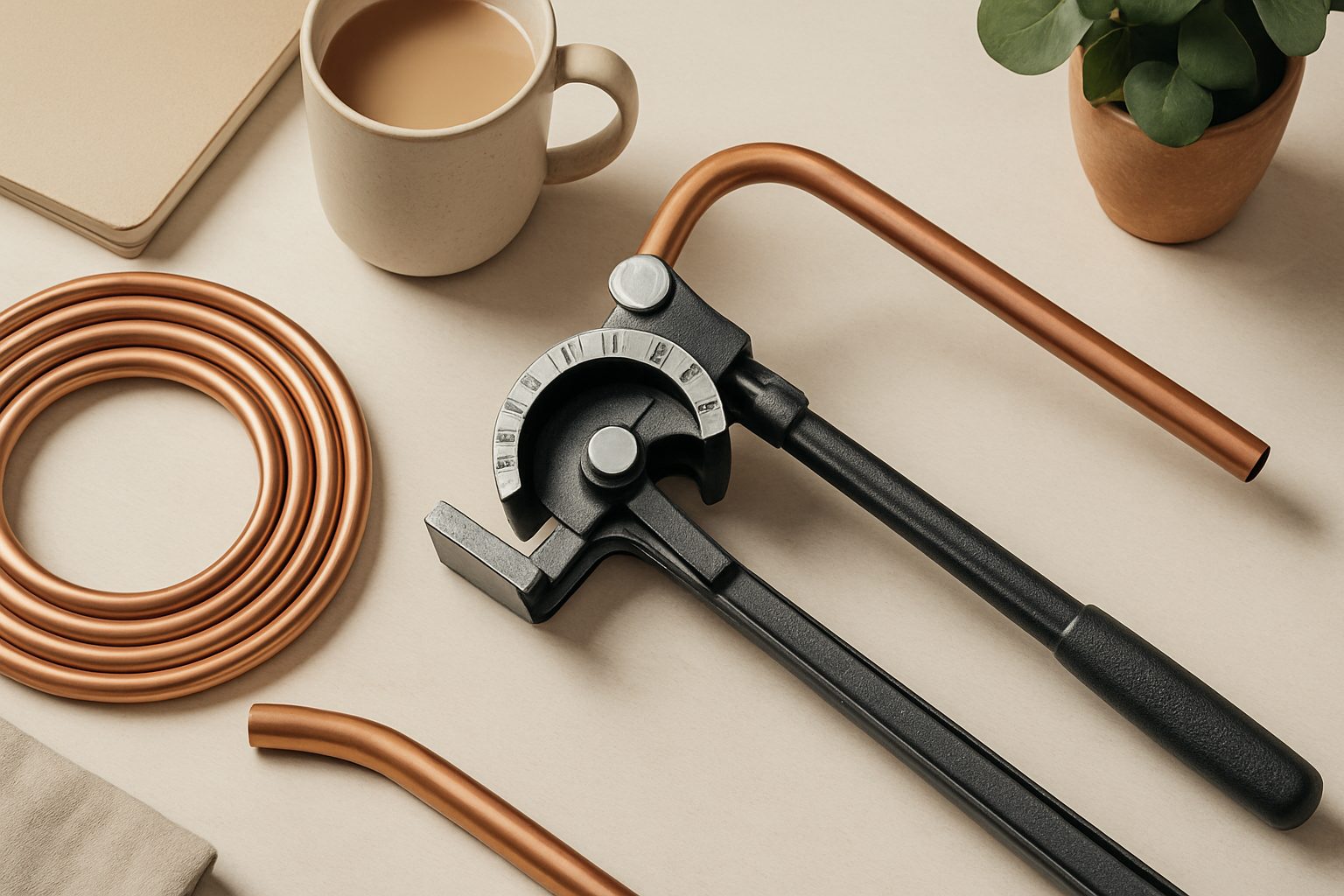
Manual benders suit homeowners doing occasional work. You feed the pipe through a former, then pull the handle—usually a lever or roller mechanism—until you've reached your target angle. The pressure is all arm strength.
Clarke and Silverline both sell manual copper benders in the £20–£40 range. These handle 6–15 mm soft copper without much fuss. The downsides are real: repetitive effort tires you quickly, and if you're new to bending, you'll get inconsistent results. The smaller radius formers also limit what shapes you can achieve—tight 90-degree bends are harder on some budget models.
Manual benders work best for short runs of pipe or one-off jobs. If you're bending ten metres of 15 mm copper for a gravity-fed heating loop, expect tired arms and variable quality.
Ratchet Benders: The Sweet Spot for Most DIYers
Ratchet-action benders use a mechanical system that multiplies your force. Instead of continuous pressure, you work a handle back and forth—like a pump jack—which gradually increases the bend angle. Each stroke adds another few degrees.
Monument makes reliable ratchet benders for copper up to 22 mm, priced around £80–£120. They're significantly easier to use than manual machines: the mechanical advantage means less strain, and the ratcheting action gives you finer control over the final angle. You can feel the tension increasing and stop at exactly 90 degrees if that's what you need.
Ratchet benders are heavier than manual ones but portable enough for a toolbag. They're accurate enough for most home plumbing and heating work, though the formers are still limited—you can't bend to every radius the pipe suits, only those the tool was designed for.
The catch: the ratchet mechanism can jam if you apply sideways pressure or try to bend material slightly thicker than spec. And they're specific to pipe diameter, so a bender for 15 mm won't work on 22 mm.
Hydraulic Pipe Benders: Professional-Grade Power
Hydraulic machines use pump pressure to bend, not arm strength. Rothenberger, a German brand widely stocked in UK tool shops, sells hydraulic benders that handle 6–42 mm copper, steel, and aluminium. A small electric pump or foot pump supplies the force; you position the pipe and activate the pump until the bend reaches angle.
Hydraulic benders are genuinely powerful and accurate. The slow, controlled pressure minimises the risk of kinking. You can achieve tight bends in thick-walled tubing that manual and ratchet tools can't touch. For professional heating engineers or DIYers doing large renovation projects, they're worth the £200–£500 outlay.
The trade-offs: they're bulky, need maintenance (the pump seals degrade), and are overkill for one-off bends in soft copper. Setup takes longer because you need to position the pipe, select the right former, and configure the pump. They're not casual DIY tools.
What Material Are You Bending?
Soft copper is easiest. It's forgiving, annealed (pre-softened), and bends consistently. Manual and ratchet benders handle it well.
Rigid copper and steel need more force. Ratchet benders struggle; you're often better with hydraulic or accept that a manual bender will be exhausting.
Plastic (MDPE water pipes, PEX heating hose) often doesn't need bending—these are flexible enough to coil. If you must bend plastic to tight radius, it won't work in any bender; heat the area with a heat gun instead.
Size and Frequency Matter
If you're bending the same diameter regularly, invest in a tool for that size. A ratchet bender for 15 mm is precise and lightweight. For multiple sizes or occasional use, a multi-size manual bender is cheaper but less reliable.
For a one-off boiler installation, rent. UK tool-hire shops stock hydraulic and ratchet benders for £15–£25 per day—much cheaper than buying if you won't use it again.
Getting the Best Results
Measure your required bend angle before you start. Don't overshoot and try to unbend; you'll work-harden the metal and risk cracking it.
Use formers matched to your pipe diameter and wall thickness. Off-spec bending damages the tube internally.
For soft copper, a gentle bend is less risky than forcing. Slow is better than fast.
Clean the pipe before bending; dirt in the former can score the surface.
Summary
Start with a ratchet bender if you're doing more than casual plumbing work—Monument's machines are reliable and reasonably priced. If budget is tight and you're bending soft copper once, a manual bender from Clarke or Silverline does the job. For serious volume or thick-walled steel, hydraulic is the only practical choice, though hire might be smarter than owning.
The best machine is the one you'll actually use. Overspending on a hydraulic bender for three bends makes no sense; undersizing to save £30 means struggle on the fourth job.
More options
- Clarke Pipe Benders (Clarke PB16F & Clarke Strongarm range) (Amazon UK)
- Silverline Pipe Benders & Spring Bender Sets (Amazon UK)
- Monument Pipe Bender & Lever Bender Range (Amazon UK)
- Hydraulic Pipe Bender Kits (12T / 16T multi-former sets) (Amazon UK)
- Rothenberger Rocbend & Copper Pipe Bender Sets (Amazon UK)